Pets · Practical luxury
A sofa, for the dog and the cat that already live there.
A pet-friendly sofa is not a category, it is a set of four decisions about fabric, colour, frame and cleanability. Get these right and the sofa survives a decade with a greyhound on it.
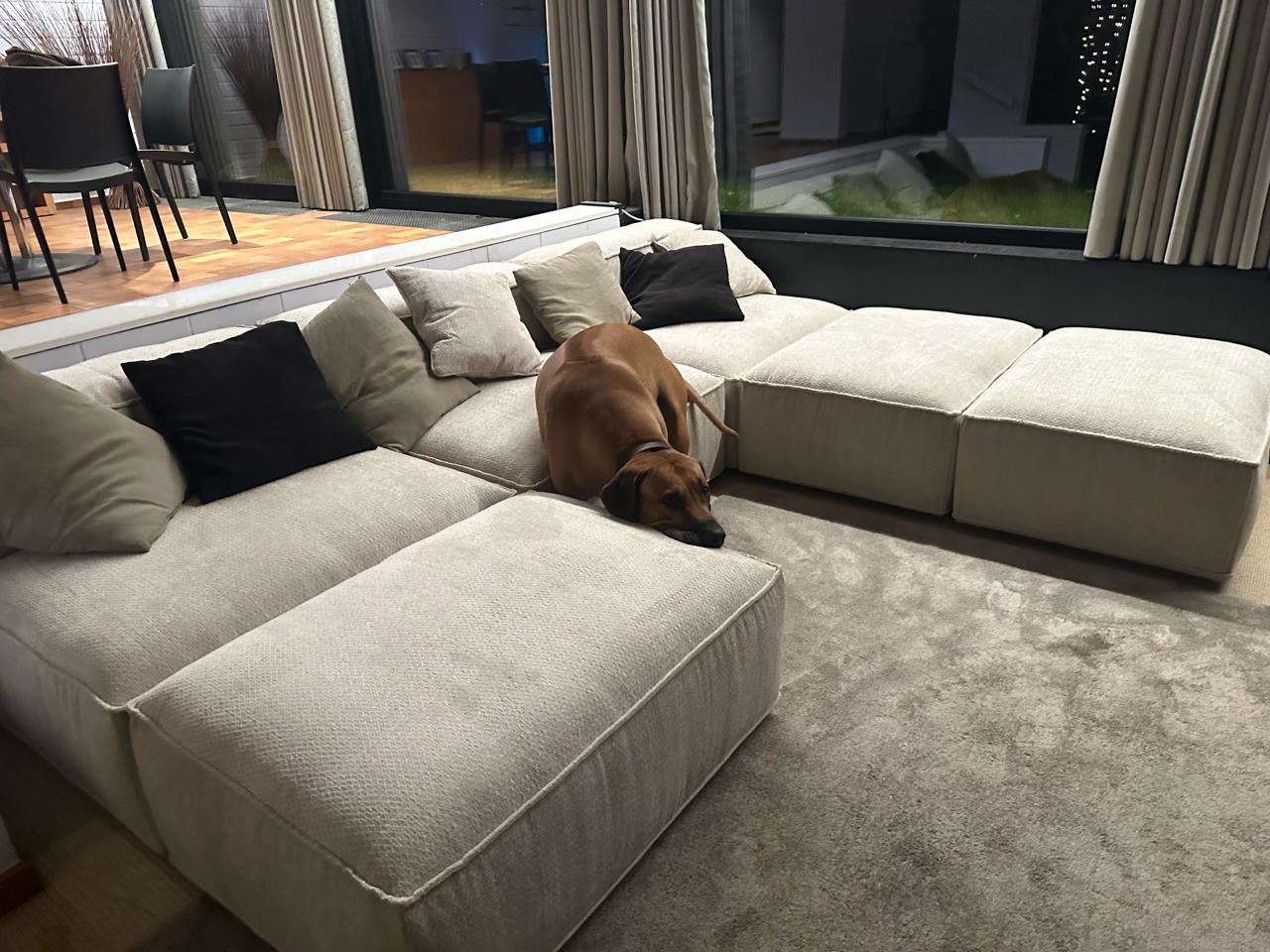
A dog will sit on your sofa. A cat will sleep on it. Both will shed onto it, jump from it, and, occasionally, defend it. The question is not whether the sofa accommodates them, it is whether it does so without becoming, after eighteen months, embarrassing.
Fabric: the weave matters more than the brand
Pets are hard on fabric in two specific ways: claws (which catch on loose loops) and hair (which weaves into open textures and never comes out). The fabrics to avoid, regardless of how beautiful they look in showrooms:
- Loose bouclé. Every loop is a hook waiting for a claw.
- Velvet and velour. Holds hair against the pile, visible at every angle.
- Pure linen. Marks at the first paw print, never fully cleans.
What works: a flat, tightly woven performance fabric with a Martindale rub count of at least 50,000, ideally with a built-in stain-resistant finish. Hair brushes off rather than bedding in.
Colour: forgiving without being depressing
The seductive trap is to choose a colour the pet "matches." A golden retriever does not match a beige sofa, it leaves a different shade of beige fur on a slightly different beige cushion. The actually-forgiving colours are graphite, smoke, deep taupe and charcoal: tones that visually absorb minor hair distribution rather than highlighting it.
A golden retriever does not match a beige sofa. It leaves a different shade of beige on it.
Frame: built for animal weight
A large dog launching onto a sofa transmits roughly four times its body weight into the frame on impact. A 30 kg labrador hits the frame at 120 kg of momentary load, every evening. Particleboard frames will not survive this. Insist on kiln-dried hardwood with glued dowel joinery; the warranty paperwork is your only evidence the brand believes in their own structure.
Cleanability and removable covers
The strongest argument for a removable-cover sofa is, frankly, the dog. When a single seat cover can be unzipped and machine-washed at 30°C, the sofa is, in effect, infinitely renewable. When the cover is permanently attached, every accident becomes a steam-cleaning appointment.
Three configurations that work
- Single dog, no children: straight three-seater in graphite performance weave, removable covers.
- Cat household: tight-back hardwood-frame three-seater, flat weave, no loose cushions to claw.
- Multi-pet, family-sized: modular corner with a longchair, the longchair becomes the pet zone, the straight side stays clean for guests.
Questions answered
Common questions
- What is the best sofa fabric for dog owners?
- A tight-weave performance fabric, flat weave, Martindale 50,000+, ideally with a stain-resistant finish. Avoid loose bouclé (claws snag), velvet (shows hair), and pure linen (marks easily). Graphite, smoke, and taupe forgive both fur and the occasional muddy paw.
- Can you use a leather sofa with a dog?
- Yes, but a heavy aniline or full-grain leather, not a corrected-grain surface. Claws can scratch the topcoat of cheaper leather almost immediately. For most pet households, a graphite performance weave outperforms leather both visually and practically.
- Which colours hide pet hair the best?
- Mid-tone neutrals that sit close to your pet's coat, graphite and smoke for black or grey animals, taupe and oat for golden or ginger ones. Pure white shows everything; jet black shows light-coloured fur and dander. Pattern and subtle texture also disguise shedding between cleans.
- Are removable covers worth it if you have pets?
- They're almost non-negotiable. A removable, machine-washable seat cover lets you deal with an accident in one wash cycle instead of a steam-cleaner visit, and replace a single damaged cover years later instead of the entire sofa. For a pet household, this is the single biggest factor in long-term sofa life.